Total population
1,798,268
On the Indus, Mianwali combines Thal agriculture with cement, coal, and power generation — including the Chashma nuclear complex. It sits on the Punjab–KP interface, with engineering and textile activity supporting a diverse economy. This page summarises district statistics, services, elected representation, and priority development challenges.
1,798,268
5,840 sq. km
3 tehsils · 51 union councils · 256 villages
| Indicator | Value |
|---|---|
| Total population | 1,798,268 |
| Tehsils | 3 |
| Union councils | 51 |
| Villages | 256 |
| Total area | 5,840 sq. km |
| Type | Count |
|---|---|
| Schools | 839 |
| Colleges | 15 |
| Facility type | Count |
|---|---|
| DHQ hospital | 01 |
| THQ hospitals | 02 |
| Civil hospital | 01 |
| Tehsil | Stations |
|---|---|
| Mianwali | 10 |
| Isa Khel | 06 |
| Piplan | 03 |
| Total | 19 |
| Tehsil | Courts |
|---|---|
| Mianwali | 12 |
| Isa Khel | 02 |
| Piplan | 03 |
| Total civil courts | 17 |
Based on listed MNAs and MPAs (NA-89–90, PP-85–88).
Illustrative rates cited in the district overview below (roads, water, education, economy, poverty).
| Constituency | Member (party) |
|---|---|
| NA-89 (Mianwali-I) | Mr. Muhammad Jamal Ahsan Khan (Independent) |
| NA-90 (Mianwali-II) | Mr. Umair Khan Niazi (Independent) |
| Constituency | Member (party) |
|---|---|
| PP-85 (Mianwali-I) | Muhammad Iqbal (Independent) |
| PP-86 (Mianwali-II) | Amin Ullah Khan (Independent) |
| PP-87 (Mianwali-III) | Ali Haider Noor Khan Niazi (PML-N) |
| PP-88 (Mianwali-IV) | Mumtaz Ahmad (Independent) |
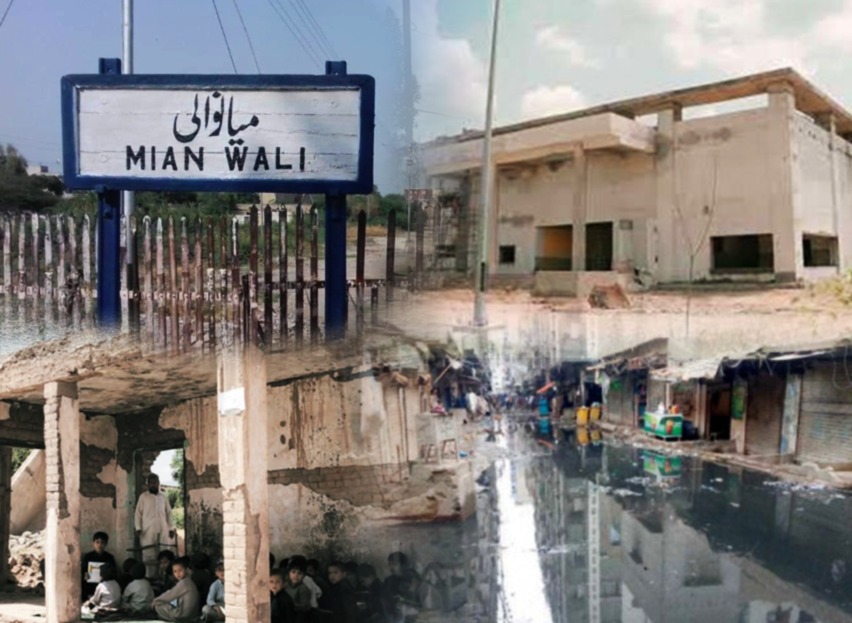
Mianwali has serious infrastructure deficiencies, with about 580 km of provincial roads remaining damaged and poorly maintained for over 15 years. Around 85% of the rural population faces isolation due to poor road conditions.
Mianwali faces a severe water crisis, with about 78% of rural households relying on contaminated groundwater. Urban areas, including Mianwali city, experience daily water shortages lasting many hours. Poor communities depend on private water tankers. Agriculture is also affected: only 45% of farmland is irrigated while the rest depends on rainfall; large amounts of water are wasted due to poor irrigation systems.
Healthcare facilities are limited, with only one hospital bed available for every 1,800 people. Major hospitals face staff shortages, and rural health units often lack electricity and medicines. Education conditions are also weak, with 47% of children out of school. Many schools require repairs, and female literacy is significantly lower than the provincial average.
Mianwali has high unemployment of around 18.2%. Agriculture productivity is low compared to other districts, and livestock losses are high.
The district has a high poverty rate of about 19.4%. Social welfare facilities, such as women shelters, are inadequate.
Mianwali is vulnerable to floods due to the Indus River, which affects areas like Piplan and Musa Khel. Past floods have caused major damage to crops and livestock.