Total population
1,957,470
West of the Chenab, Bhakkar blends Thal and riverine agriculture with cotton ginning, sugar, and small-scale industry. The district headquarters at Bhakkar City anchors services for a largely rural population and connects the division to southern Punjab corridors. This page summarises district statistics, services, elected representation, and priority development challenges.
1,957,470
8,153 sq. km
4 tehsils · 64 union councils
| Indicator | Value |
|---|---|
| Total population | 1,957,470 |
| Tehsils | 04 |
| Union councils | 64 |
| Total area | 8,153 sq. km |
| Type | Count |
|---|---|
| Schools | 927 |
| Colleges | 19 |
| Facility type | Count |
|---|---|
| DHQ hospital | 01 |
| THQ hospitals | 03 |
| Measure | Count |
|---|---|
| Total police stations | 11 |
Based on listed MNAs and MPAs (NA-91–92, PP-89–93).
Dysfunctional rural drinking-water schemes and unemployment-to-population ratio. Roads and health are described in the narrative.
| Constituency | Member (party) |
|---|---|
| NA-91 Bhakkar-I | MNA Mr. Sana Ullah Khan Mastikhel (Independent) |
| NA-92 Bhakkar-II | MNA Sardar Rashid Akbar Khan (PML-N) |
| Constituency | Member (party) |
|---|---|
| PP-89 Bhakkar-I | MPA Ameer Muhammad Khan (Independent) |
| PP-90 Bhakkar-II | MPA Ahmad Nawaz Khan (PML-N) |
| PP-91 Bhakkar-III | MPA Ghazanfar Abbas (Istehkam-e-Pakistan Party) |
| PP-92 Bhakkar-IV | MPA Muhammad Aamir Inayat Shahani (PML-N) |
| PP-93 Bhakkar-V | MPA Saeed Akbar Khan (PML-N) |
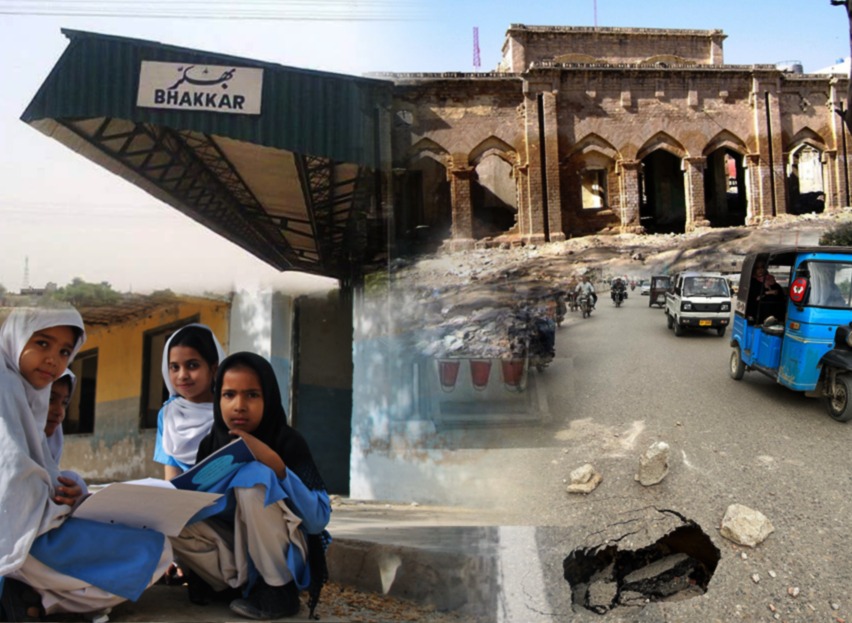
Bhakkar’s 2,671.3 km of key roads remained in severe disrepair for over a decade until FY 2025, causing travel disruptions, accidents, and economic losses.
Over 65% of rural drinking-water supply schemes in Bhakkar have been reported as dysfunctional, leaving communities without access to clean water.
Heavy pressure on health facilities: on average one hospital is available per 326,245 population, including 1 DHQ and 3 THQs. The bed-to-patient ratio is about 2,711 persons per bed (including RHC and BHU beds).
Limited industrialization means fewer employment opportunities. The unemployment-to-population ratio is 11.7%.